

How to Boost AI Visibility in Search Algorithms
Summarize with
As AI shopping assistants like ChatGPT, Google Gemini, Perplexity, and voice assistants become primary product discovery tools, e-commerce businesses must optimize for AI visibility alongside traditional search. This guide provides actionable strategies for making your products discoverable, understandable, and recommendable by artificial intelligence systems.
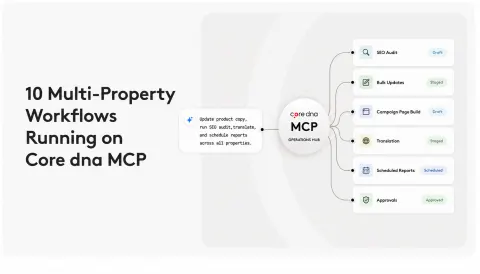
For enterprise teams, the same machine-readable structure matters operationally too; Core dna’s recent MCP examples show how multi-property AI workflows can move from manual requests to governed agent execution.
Understanding AI-Powered Product Discovery
AI systems are fundamentally changing how consumers discover and purchase products. Instead of browsing categories or searching keywords, users ask conversational questions like 'What's the best noise-cancelling headphones under $200 for travel?' or 'Find me eco-friendly athletic wear for hot weather.' AI assistants parse these queries, understand intent, evaluate products across the web, and provide curated recommendations.
For your products to appear in these AI-generated recommendations, they must be discoverable across key platforms and structured for machine understanding.
This requires a two-pronged approach: strategic platform presence and technically optimized product infrastructure on your website. This shift is often described as Answer Engine Optimization (AEO) and Generative Engine Optimization (GEO). AEO focuses on structuring content so AI systems can confidently answer specific questions. GEO focuses on ensuring your products are selected inside AI-generated recommendations.
The Foundations of Boosting AI Visibility: Moving from “Keywords” to “Data Confidence”
In the traditional SEO era, visibility was a competition for rank. In the agentic era of 2026, visibility is a competition for inclusion. When a user asks an AI assistant like Gemini or a ChatGPT-powered search agent for a recommendation, the system doesn’t look for a page to rank. It looks for an entity it can recommend with sufficient confidence.
To become that entity, we must understand two foundational pillars of AI trust: the Google Shopping Graph and implicit trust signals.
 1. The Intelligence Layer: The Google Shopping Graph
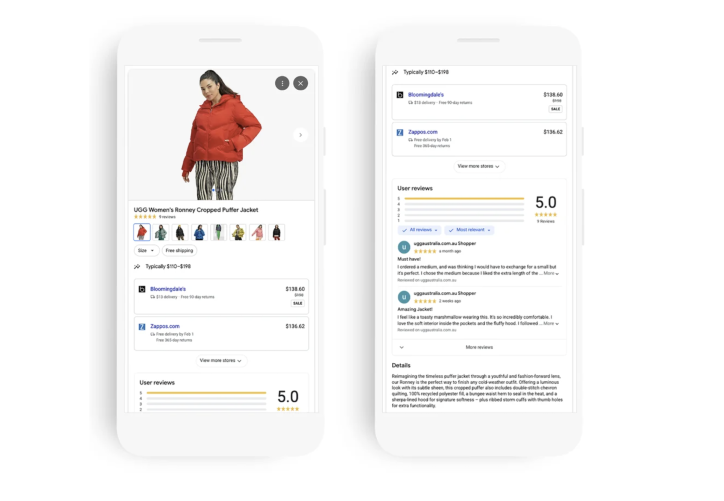
The Google Shopping Graph is Google’s large-scale commerce intelligence system. It aggregates tens of billions of product records and relationships between products, sellers, brands, prices, availability, and reviews to support AI-driven shopping experiences.
Conceptually, the Shopping Graph operates similarly to Google’s Knowledge Graph but is purpose-built for commerce. It uses retrieval-based techniques to supply AI systems with verified product facts drawn from merchant feeds, structured website data, and trusted third-party sources.
Why real-time consistency matters
AI-powered shopping systems prioritize reliability over relevance. If your website’s pricing, availability, or attributes diverge from what Google has ingested through Merchant Center or structured data, the system reduces confidence in your entity. When confidence drops below a practical threshold, products are quietly excluded from AI-generated recommendations to avoid presenting outdated or unreliable information to users.
The Shopping Graph is not just a marketing channel. It functions as part of your technical identity inside Google’s ecosystem, helping AI systems validate that your product exists, is available, and can be safely recommended.
2. Confidence Thresholds and “Trusted Entities”
AI systems do not arbitrarily pick brands. They evaluate confidence thresholds based on how consistently an entity’s data is represented across the web. To an AI agent, a brand is an entity, a collection of verifiable facts such as product identifiers, attributes, pricing, availability, and reputation signals.
If your product is labeled “eco-friendly” on your website, but that attribute is absent or contradicted on Amazon listings, manufacturer feeds, or review platforms, the AI detects a conflict. Conflicting information introduces risk, and risk reduces inclusion.
The penalty of friction
In conversational interfaces that surface only one to three recommendations, even small inconsistencies can push an entity below the confidence threshold required to appear at all. Visibility loss in AI systems is rarely gradual. It is often silent and binary.
Enterprise teams must aim for high-confidence entity status by ensuring that public-facing data, from SKU attributes to fulfillment promises, is consistent, verifiable, and aligned across major platforms.
3. Implicit Trust Signals (The 2026 Evolution of E-E-A-T)
Beyond structured data, AI systems evaluate implicit trust signals to determine whether a brand is worth recommending. These signals function as the modern equivalent of backlinks. AI systems look for clear organizational identity through signals such as Organization schema, consistent brand naming, and authoritative profile connections (for example, LinkedIn, Wikipedia, or established industry databases).
Community consensus
In 2026, AI systems increasingly interpret platforms like Reddit, niche forums, and YouTube transcripts as indicators of real-world sentiment. Strong technical data can be outweighed by persistent negative community feedback such as “frequent returns” or “poor customer service.”
AI agents also evaluate the gap between promises and outcomes. If shipping claims, return policies, or availability statements consistently conflict with public review data, this creates a negative trust signal that lowers recommendation priority.
The Technical Checklist for Building "Agent-Ready" Infrastructure
In 2026, Technical SEO has transitioned into Agentic Infrastructure, forming the foundation for Answer Engine Optimization (AEO) and Generative Engine Optimization (GEO). To ensure that AI agents can find, trust, and ultimately transact with your products, your technical team must focus on machine-readable reliability and interoperability.
1. Adopt Emerging Agent-Access Standards (UCP)
A pivotal moment in early 2026 was the official launch of the Universal Commerce Protocol (UCP). This open-source standard, provides a common language for AI agents to communicate with merchant backends.
The /.well-known/ucp Manifest, similar to how robots.txt governs crawlers, the UCP manifest is the emerging standard for agentic capability discovery. By hosting a JSON manifest at this path, you allow AI agents to:
- Programmatically Discover Capabilities: Instantly identify support for guest checkout, loyalty integration, or delivery constraints without scraping the UI.
- Standardize Interaction: Move toward "Native Checkout" experiences where AI assistants (like Gemini or OpenAI's search agents) can manage the transaction lifecycle through standardized API handshakes.
What this means for your eCommerce Platform.
For most enterprise teams, UCP adoption is a platform requirement. Your responsibility is to ensure that:
- Your eCommerce platform and CMS support UCP manifests natively or via extensions
- Your checkout, pricing, and inventory systems can be safely exposed through standardized APIs
- Your vendor roadmap explicitly includes agent-access support, not just traditional SEO or feed management
2. Product Identity Resolution (The "Unique ID" Mandate)
AI systems use Global Product Identifiers to resolve "Entity Ambiguity." Without these, an AI cannot definitively link a mention of your product on a review site to the listing on your store.
- GTIN/MPN Integrity: High-resolution commerce requires a GTIN (Global Trade Item Number) or MPN (Manufacturer Part Number) at the SKU level.
- The Resolution Risk: If an AI finds conflicting identifiers for what appears to be the same item, it faces a "data collision." To maintain "sufficient confidence," the AI will often choose to exclude the product rather than risk recommending the wrong version to a user.
It's important to audit your PIM (Product Information Management) system. Every variant (size, color, material) must have a unique, industry-standard identifier that remains consistent across your entire distribution network.
3. Advanced Schema Relationships & Deep Metadata
Basic Schema is no longer a differentiator; it is a prerequisite. To meet the confidence thresholds required for AI recommendation, you must provide Relational Metadata.
With Explicit Entity Linking, you use relationship-oriented Schema to eliminate ambiguity:
- isRelatedTo: Explicitly define compatible accessories or "essential additions" to prevent the AI from guessing.
- hasMeasurement: Provide precise dimensions and weight in standardized formats. This allows AI agents to verify shipping eligibility before recommending the product.
- inventoryLevel (via Extensions/Feeds): Move beyond binary "In Stock" labels. Providing verified stock counts via extended merchant schemas ensures that AI agents can confidently recommend your store for high-volume or urgent orders.
Task your SEO team with a "Schema Audit." We are moving from "describing a page" to "defining a graph of related products."
4. Latency Targets & Performance Health
AI agents are computationally expensive to run. Because they must synthesize data in real-time, they prioritize merchants who provide the fastest "Time to Ground Truth."
- The Low-Latency Target: While human users might tolerate a 2-second load, AI agents often operate with strict sub-second timeouts. Aim for API response times under 200–300ms for inventory and pricing checks to ensure you aren't timed out of the recommendation set.
- Server-Side Rendering (SSR): AI bots in 2026 prioritize "pre-rendered" data. If your product details are hidden behind client-side JavaScript, the AI's "cost to crawl" increases, making your store less attractive for frequent indexing.
5. Intentional Data Governance (Robots.txt)
Visibility is no longer a binary "on/off" switch. You must now manage access based on the intent of the crawler.
Differentiating Training vs. Retrieval:
- Allow OAI-SearchBot / Googlebot: These handle real-time retrieval and discovery. Permitting these agents is critical for appearing in live AI-generated answers.
- Manage GPTBot / Google-Extended: These are typically used for model training. Managers must decide if the long-term value of training the model outweighs the risk of data scraping.
The "Zero-Party" Feed: High-scale retailers are now deploying dedicated, "slop-free" factual feeds specifically for AI crawlers, ensuring that the machine receives data in its most efficient format.
In the same governance spirit, some teams publish an llms.txt file, a curated index of the pages they most want AI systems to read.
Technical excellence in 2026 is measured by Machine-Readability. If an AI agent cannot resolve your product identity via GTIN, verify your availability in milliseconds, and discover your checkout protocol via UCP, your brand will remain invisible to the agentic economy."
Designing Content for Answer Engine Optimization (AEO)
While infrastructure allows agents to find you, your content strategy determines if they cite you. AI models use Retrieval-Augmented Generation (RAG) to ground their answers in factual information, prioritizing content that is easy to extract and summarize.
The Answer-First Content Model
To succeed in AEO, you must adopt an "answer-first" structure. This involves placing a concise, direct answer—typically 40–60 words—at the very beginning of a relevant section. AI systems extract these top-level statements before scanning supporting text, significantly increasing the likelihood of being cited as the definitive source.
Semantic Structure and Narrative Clarity
AI models prefer content organized around a clear narrative with "Single-Threaded" sections. Use semantic triples (Subject → Predicate → Object patterns) to make relationships crystal clear. For instance, a clear statement like "The [Product][is compatible with][Model X]" provides a direct fact that is easily mapped into an LLM’s knowledge base.
Multi-modal Discovery: Beyond Text Optimization
In 2026, discovery is multi-modal. AI systems now combine text, images, and video to provide richer, more contextual results.
The Visual Knowledge Graph and the "Object Bible"
AI does not isolate your product in an image; it scans every adjacent object to build a contextual database. Brands are now developing "Object Bibles"—standardized lists of props and background elements that send consistent signals to vision models regarding price point, luxury status, or utility.
OCR-Friendliness and Video Intelligence
Packaging design must prioritize OCR (Optical Character Recognition) friendliness, using high-contrast fonts and avoiding glossy materials that reflect light and break up text. For video, providing accurate, timestamped SRT transcripts allows AI engines to index specific chapters and cite them directly for "How-to" queries.
Informal Credibility Optimization (ICO): Building "Community Trust"
AI models calibrate brand relevance based on human consensus across communities like Reddit, Quora, and niche forums. This is known as Informal Credibility Optimization (ICO).
- Seeding Authentic Sentiment: Since LLMs learn from user-generated discussions, organic mentions in relevant subreddits or forum threads function as modern-day backlinks.
- Monitoring "Persistence Bias": AI systems prefer sources that remain stable and frequently referenced over time. Brands must actively monitor their reputation on review platforms, as negative patterns like "frequent returns" can lower an entity's confidence score and lead to exclusion from recommendations.
Agentic Trust Scoring (ATS): The Mathematics of Inclusion
In the agentic economy, trust is a mathematical score (Agentic Trust Scoring) used by programs to make purchasing decisions.
- The Zero-Tolerance Policy for Inventory Drift: Agents are "ruthless." If a transaction fails because an item is out of stock despite being listed as available, the agent will "downgrade" the merchant’s trust score in decentralized reputation ledgers.
- Reliability Benchmarks: To maintain inclusion in agent-led shopping flows, merchants must target an Order Defect Rate (ODR) of less than 0.1%.
Measuring Visibility: The New KPI Framework
Traditional metrics like click-through rates are becoming secondary to influence-based KPIs.
- AI Share of Voice (SoV): This measures how frequently your brand is explicitly mentioned in synthesized answers compared to competitors.
- Citation Share and Sentiment: Track how often your brand is cited with a link and the sentiment of those citations (positive recommendation vs. neutral mention).
- Assisted Conversions: Monitor users who discover your brand through an AI interaction and convert later through a direct or branded search.
The Strategic Roadmap for Boosting Visibility in AI Search Algorithms
The trajectory of AI search suggests a total reconfiguration of the eCommerce funnel. By 2027, it is predicted that half of all retail executives anticipate the collapse of the multi-step shopping journey into a singular AI-driven interaction.
By 2028, AI agents are expected to intermediate over $15 trillion in B2B spending. To survive this shift, eCommerce businesses must transition from being a destination for human eyes to becoming a "Source of Truth" for machine-led discovery. Excellence in 2026 is measured by machine-readability, data integrity, and the strength of your brand’s presence in the web’s implicit trust layers.
Summarize with