
CUSTOM ENTITIES

Model your business. Don't adapt to software.

Model your business. Don't adapt to software.
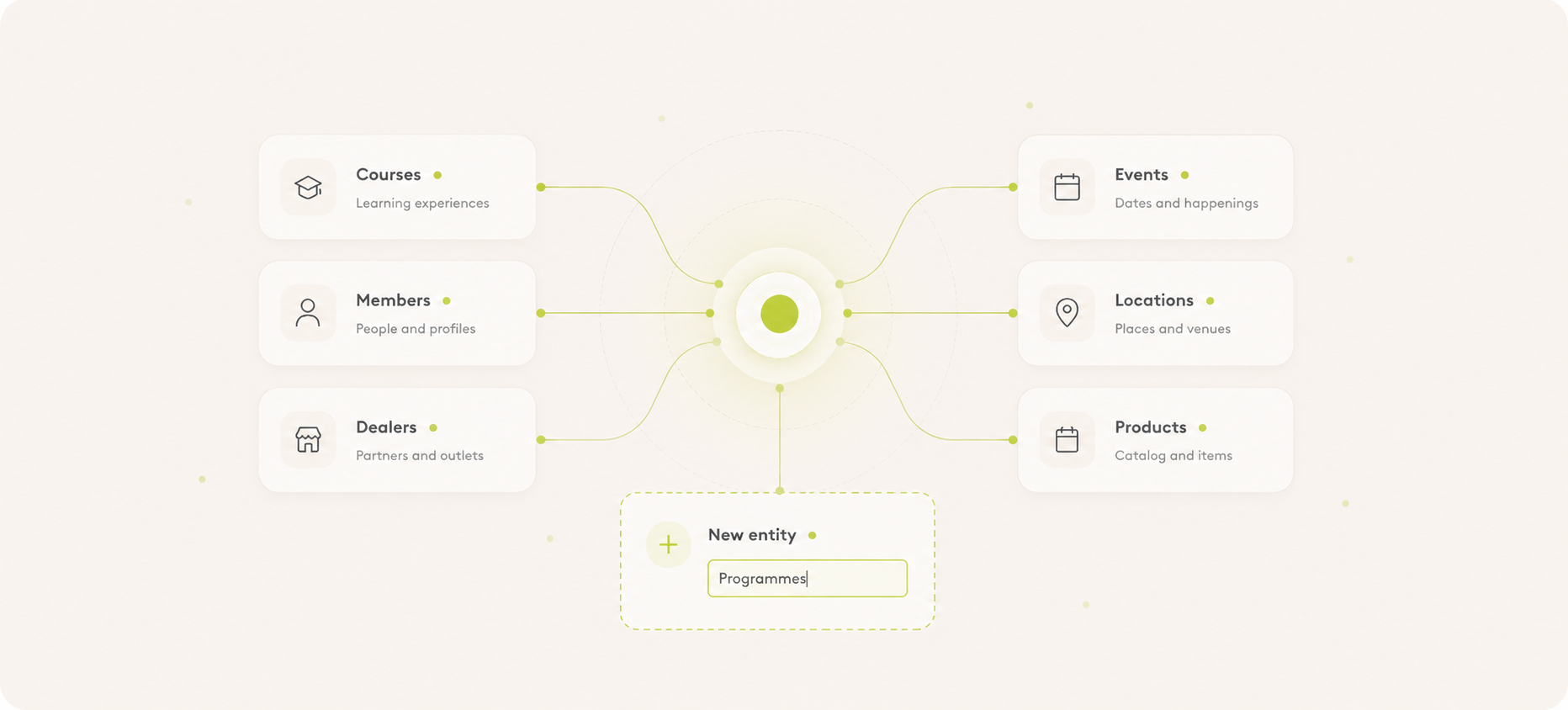
WHAT YOU CAN MODEL the objects each operator already runs on

Every Core dna customer models their business.

MEMBERSHIP ORGANISATIONS MEMBERS · TIERS · CHAPTERS · RENEWALS · EVENTS

Model members, tiers, and chapters as living records.

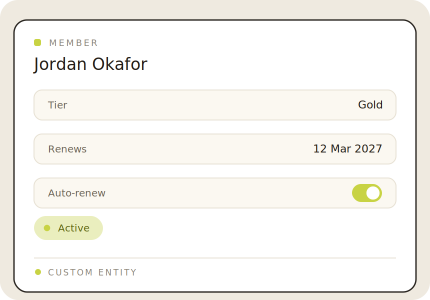
Members, membership tiers, chapters, renewals, and member events become entities with their own fields and relationships. Gated content, renewal dates, and member portals all read the same record.

Members Tiers Chapters Renewals Events
DISTRIBUTORS AND B2B DEALERS · ACCOUNTS · PRICE BOOKS · TERRITORIES · RFQS

Model dealers, accounts, and price books as data.

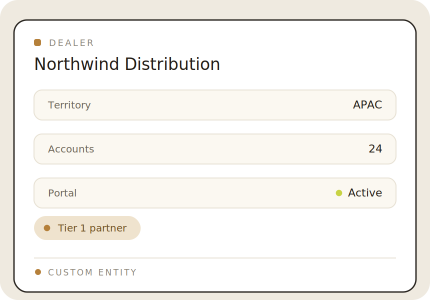
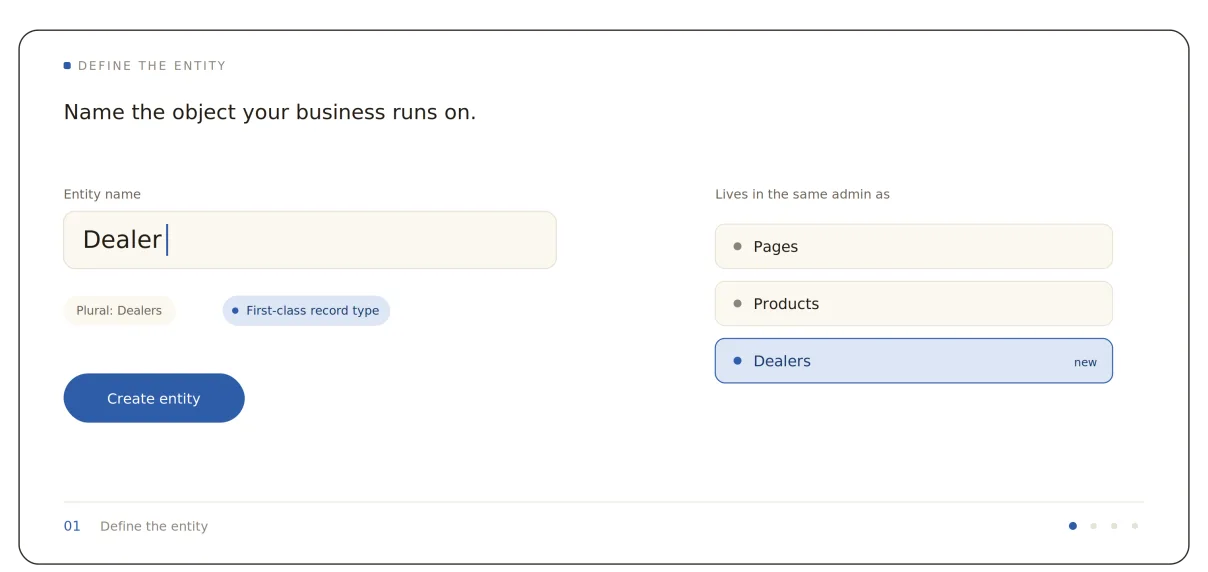
Dealers, B2B accounts, contract price books, territories, and RFQ history become first-class records, each carrying the fields, pricing, and relationships the trade relationship actually needs.

Dealers Accounts Price books Territories RFQs
FRANCHISE NETWORKS LOCATIONS · FRANCHISEES · LOCAL STOCK · SERVICES

Model every location and franchisee as structured data.

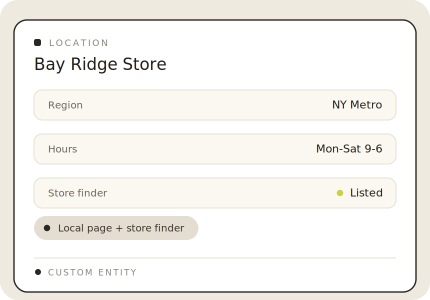
Locations, franchisees, local stock levels, and location-specific services become entities that power store finders, local pages, and per-location operations across the network.

Locations Franchisees Local stock Services
MULTI-BRAND RETAIL PRODUCTS · VARIANTS · SPECS · CONFIGURATIONS · BRANDS

Model complex products, specs, and configurations.

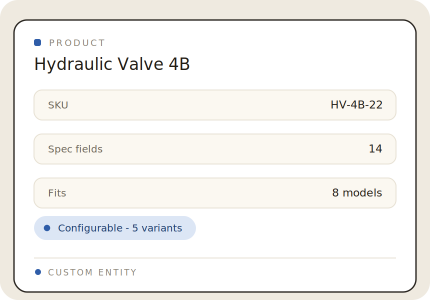
Products, variants, technical specs, configurations, and brand-specific attributes become structured records that reach beyond a standard catalogue, searchable and shoppable across every brand.

Products Variants Specs Configurations Brands
LEARNING AND CERTIFICATION COURSES · MODULES · CERTIFICATIONS · COHORTS · SESSIONS

Model courses, certifications, and cohorts as data.

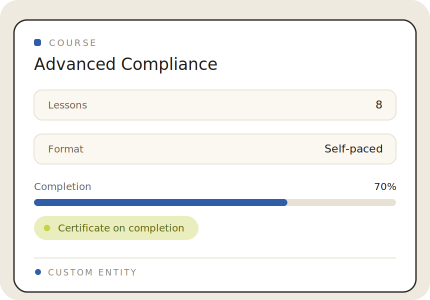
Courses, modules, lessons, certifications, learners, cohorts, and session schedules become entities, with completion tracking and certificates running on the same records.

Courses Modules Certifications Cohorts Sessions
NON-PROFIT AND CAUSE DONORS · PROGRAMMES · BENEFICIARIES · GRANTS · EVENTS

Model donors, programmes, and beneficiaries.

Donors, programmes, beneficiaries, grants, and fundraising events become structured records, each with the fields, relationships, and reporting a cause-led organisation runs on.

Donors Programmes Beneficiaries Grants Events
WHAT YOU CAN BUILD

One platform. Any object.

Courses & certifications
01

Courses & certifications

Run a full learning and certification platform, with lessons, completion, and certificates.

See LMS
Members & renewals
02

Members & renewals

Model members, tiers, and renewals, with gated content and member portals.

See membership
Dealers & partner networks
03

Dealers & partner networks

Give dealers, partners, and franchisees their own branded portals and data.

See franchise
Locations & directories
04

Locations & directories

Model every location as structured data that powers store finders and local pages.

See multi-location
Product catalogs & specs
05

Product catalogs & specs

Model complex products, specs, and relationships beyond a standard catalog.

See eCommerce
Events & programs
06

Events & programs

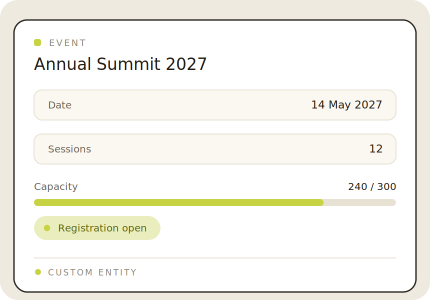
Model events, sessions, and programs with the fields and rules they actually need.

HOW IT WORKS

Model it in four steps.

Define it in admin, live across every property the same day.

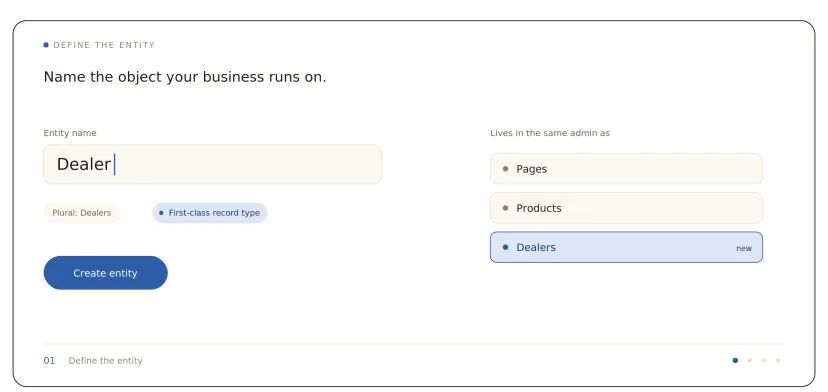
Define the entity
ANY BUSINESS, ANY OBJECT

Whatever your business runs on, you model it.

Members, tiers, and chapters. Courses, modules, cohorts, and certifications. Dealers, accounts, territories, and price books. Locations, franchisees, and services. Events, sessions, venues, and capacity. Donors, programmes, beneficiaries, and grants. Assets, bookings, and availability. Listings, providers, and appointments. Delivery slots, vendors, and variable-weight products. If your business runs on it, you model it as a custom entity, with its own fields, relationships, and screens, on the same platform as your site and store.

Model the entity once. Search, forms, commerce, and agents read it live.

Search and discovery

The moment an entity goes live, search indexes it. Dealers, courses, donors, and locations become searchable, faceted, and ranked by the same engine that indexes products and content, the moment anything changes.

Forms and data capture

A form submission creates or updates an entity record in the same operation. Applications, renewals, dealer sign-ups, and claims write straight to the entity, then flow on to search, hooks, and the customer record.

Commerce and orders

An entity transacts. A course enrols and charges, a membership renews and bills, a configured product orders, all on the same commerce engine that runs the storefront, against the same record.

Hooks and workflows

Any change to an entity fires a hook. A new dealer triggers onboarding, an expiring membership triggers a renewal flow, a status change escalates to approval, each reading the record that changed.

Content and gated access

The CMS gates content against the entity record. A member tier unlocks a library, a certification opens a resource, a dealer agreement reveals trade pricing, checked against the live record on every request.

Personalisation

The storefront and CMS personalise against entity fields. Member status, dealer tier, location, and language already live on the record, so what each visitor sees follows the entity.

Pages and views

Every entity generates its own list, detail, and admin screens. A directory, a course catalogue, a store finder, and a member portal each render from the entity, one template per type.

Agentic and MCP

Every entity is exposed via MCP. Claude, ChatGPT, or a custom agent reads, creates, and updates records on the live model, scoped to the same permissions as a human operator.

CUSTOMER PROOF

Save a Life runs a full certification platform on Core dna

Save a Life replaced three separate systems with one Core dna platform, and now models courses, certifications, members, and checkout as data in a single place. Read the story.

3 → 1 CMS, LMS, and commerce consolidated onto one platform
[N] pages Translated to Spanish overnight with agentic workflows
[N] hrs Agentic translation time, instead of [N] weeks by hand
[N] courses Courses and certifications modelled as custom entities
VS THE ALTERNATIVES

Model anything. Without the engineering project.

Capability
Rigid SaaS
Fixed objects. Pages, posts, products.
Composable stack
Headless plus custom services, assembled by engineers.
Core dna
Model any object in one platform, no code.
Modelling your business
Can the platform represent your real objects?
Fixed
You bend your business to fit pages, posts, and products.
Anything
Model anything, if you build and maintain the services.
Anything
Model courses, members, dealers, or locations as first-class data.
Who builds it
Who does the modelling work?
No one
The object you need doesn't exist and can't be added.
Engineers
Every new object type is a development project.
Your team
Model objects in admin, with no custom code to do the modelling.
Time to first model live
How fast a new object type ships
Never
Outside the product's fixed schema.
Weeks
Design, build, test, and deploy the services.
Same day
Define it, model the fields, publish it.
Adding the next object
What it takes to add another type
Not possible
You buy another tool instead.
New project
Repeat the engineering work.
Configuration
Add another entity in admin.
Where your data lives
How fragmented your data becomes
Across tools
One more system bolted on for each object.
Across services
Spread across the services you assembled.
One platform
Every object in the same platform as your site and store.
Modelling your business
Can the platform represent your real objects?
Rigid SaaSFixed
You bend your business to fit pages, posts, and products.
Composable stackAnything
Model anything, if you build and maintain the services.
Core dnaAnything
Model courses, members, dealers, or locations as first-class data.
Who builds it
Who does the modelling work?
Rigid SaaSNo one
The object you need doesn't exist and can't be added.
Composable stackEngineers
Every new object type is a development project.
Core dnaYour team
Model objects in admin, with no custom code to do the modelling.
Time to first model live
How fast a new object type ships
Rigid SaaSNever
Outside the product's fixed schema.
Composable stackWeeks
Design, build, test, and deploy the services.
Core dnaSame day
Define it, model the fields, publish it.
Adding the next object
What it takes to add another type
Rigid SaaSNot possible
You buy another tool instead.
Composable stackNew project
Repeat the engineering work.
Core dnaConfiguration
Add another entity in admin.
Where your data lives
How fragmented your data becomes
Rigid SaaSAcross tools
One more system bolted on for each object.
Composable stackAcross services
Spread across the services you assembled.
Core dnaOne platform
Every object in the same platform as your site and store.
FAQ

Questions teams ask before they model their first entity.

No. You define an entity in admin: name it, add its fields, set its relationships, and build its screens. The work is configuration, the same kind of work as building a page or a product. If you can describe the object in a spreadsheet, you can model it in Core dna.
Same day. You define the entity, model its fields and relationships, and publish, on the same release path as a page or a product. Adding the next entity is more configuration, not another project.

Yes. Every entity generates list, detail, and admin views from one template per type. A dealer directory, a course catalogue, a store finder, and a member portal all render directly from the entity, public-facing and searchable.

Yes. An entity runs on the same commerce engine as the storefront. A course enrols and charges, a membership renews and bills, a configured product orders, each against the live record, in one operation.

Yes. Search indexes an entity the moment it goes live, faceted and ranked by the same engine that indexes products and content. Every entity is also exposed via MCP, so Claude, ChatGPT, or a custom agent reads, creates, and updates records, scoped to the same permissions as a human operator.

Through one-to-many, many-to-many, and parent-child relationships. A dealer has many locations, a course belongs to many cohorts, a member holds one tier. Search, forms, and pages all follow the relationships you model.

Yes. Connector-based ingestion brings data from ERPs, PIMs, and existing systems into a custom entity. Once mapped, the records are searched, ranked, transacted, and governed by the same platform as native data.

Yes. Entities inherit the same governance as the rest of the platform: per-entity permissions, revisions with restore-to-active, approval flows, and a full audit log. The control model that ships a content change ships an entity change.

GET STARTED

Model your business on Core dna.

Book a 30-minute call. We will model one of your objects live, so you can see it work before you commit.