AGENTIC OPERATIONS PLATFORM FOR MEMBERSHIP NETWORK

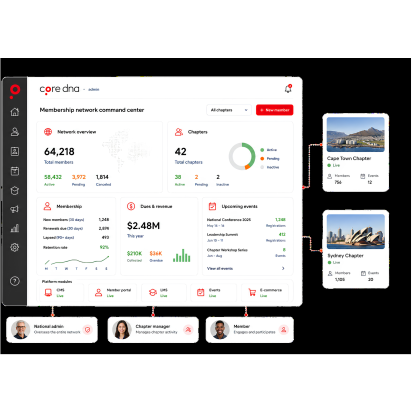
Operate the whole membership network from one platform

Built for national bodies with 5 to 200 chapters and 5,000 to 500,000 members. Members, chapters, programs, and dues modelled as first-class entities. The CMS, member portal, LMS, and event registration on one platform, not five contracts.


Hero Image
TRUSTED BY MEMBERSHIP NETWORK OPERATORS

Membership networks already operating on Core dna: 5 to 200 chapters. 5,000 to 500,000 members. One platform behind every one of them.

G2 Enterprise
DXP
★★★★★
4.5

Modelled to your organisation. Configured to how you run it.

Members, chapters, programs, and dues
Master and local content, scoped to chapters
Subscription billing and dues renewal built in
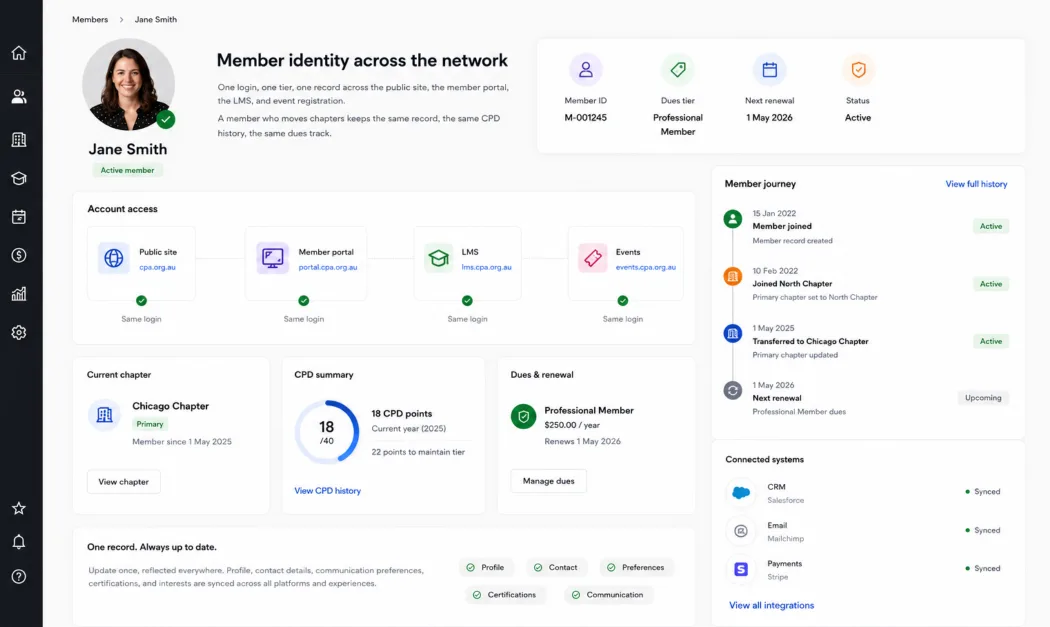
Member identity across the network

Describe the change. Every chapter ships it

Describe the change in plain language; the platform ships it across every property, with approval and audit built in.

  • Renewal communications across every chapter: Update the professional-tier renewal copy on every chapter site and refresh the linked CPD compliance language.
  • Chapter-level brand rollouts.: Roll the new visual identity across every chapter site, keeping the local sponsor logos and event listings intact.
  • Cross-system reporting: Show me dues at risk this quarter by chapter, with CPD compliance status.
Image
BUILT FOR YOUR KIND OF MEMBERSHIP NETWORK The platform configures to your shape, not the other way around

Different networks need different things. Here is what Core dna ships for the four most common kinds.

Custom entities, master and local content, subscription billing, member portal, LMS, event registration, are the same across every membership shape. What changes is how they are configured for the way your organisation actually runs.

01 Professional associations and federations

Member-and-firm dues, annual conference, and advocacy

Individual members and member firms on the same tier model. Conference registration, member directory, and advocacy content scoped to active members.


Learn more
02 Community and recreation networks

YMCAs, community centres, recreation networks

Family and individual tiers. Activity finders pulled live from across multiple program catalogs. Donor and volunteer pages share one identity model.

Learn more
03 Certification and CPD networks

Certifications, provider cards, and CME credit tracking

Course completion and CME-accredited certification on the same stack. Free tier feeds the paid tier. Provider cards and credit tracking sit in the member record


Learn more
04 Cultural and institutional memberships

Museum, and cultural-institution memberships

Annual memberships with tiered access, members-only events, ticketed exhibitions, and donor crossover. One record across membership, event registration, and annual giving.


Learn more
CUSTOMER STORY YMCA of Greater Toronto. 19 properties. 440 locations. Replaced Sitecore.

Our new digital platform with
Core dna transformed how we engage members. Now we control content, track registrations, and launch new programs independently.

Saad Javed
Digital Marketing Manager, YMCA of Greater Toronto
500%
increase in online registrations
19
digital properties
440
locations
1
platform

Built for membership complexity.

Core dna is built for brands that need to manage scale, multiple locations, multiple regions, local variations, without rebuilding for every new region, locking marketers out of changes, or adding three more vendors to your stack.

Plug into the stack you already run.

Certified integrations across payments, fulfillment, marketing, and analytics, with a marketplace that ships weekly.

140+
Certified integrations
30+
Solution partners
99.9+%
API uptime
< 90d
Avg. time-to-launch
Commerce 38 apps
Stripe Adyen Klarna PayPal Affirm Avalara +32
Fulfillment 24 apps
ShipStation Easypost Shippo Flexport +20
Marketing 46 apps
Klaviyo Braze Segment Iterable Mailchimp +41
Analytics 32 apps
Snowflake BigQuery Redshift Amplitude +28

What it’s like to work with Core dna

Most franchise networks go live in 6 to 10 weeks. The people who build the platform run the implementation.

Phase 1
We start with your network, not a template

Most AMS migrations overrun because teams try to move everything at once without a proven model. We establish the model with one chapter cohort first, then scale across the network.

Phase 2
We configure, you don't rebuild

Your existing systems, AMS, payment processor, email marketing, connect to the platform. Your chapters get their own scoped admin, content, and member rules. 

Phase 3
We prove the model with one chapter cohort

We establish how the platform operates for your network, validate it against a real renewal cycle, and confirm it works with one chapter pilot. Then we scale across the rest.  

Phase 4
The same team stays after launch

Once you are live, the people who configured the platform keep working with you. New chapter, new program, new region, the platform grows with the network without becoming another project.

VS THE ALTERNATIVES

Why membership networks outgrow their first stack.

AMS plus CMS plus LMS stack, WordPress plus plugins, or one configured platform. If you run under 1,000 members with one location and no chapter structure, simpler tools like MemberPress or Memberful are usually enough. Core dna is for chapter-based networks with multiple programs, CPD or certification, and a digital team that wants to ship without a six-month integration project every quarter.

Capability
AMS + CMS + LMS
Separate purchases · stitched together
WordPress + plugins
MemberPress, PMP, WooCommerce
Core dna
Configured platform · members, chapters, programs, dues
Time to first chapter live
How quickly the first chapter goes live
6 to 12 months
Across vendors. Discovery, integration, and reconciliation across AMS, CMS, and LMS extends every timeline.
Fast initially
Quick to assemble for a single chapter, but breaks at multi-chapter scale as plugin and theme assumptions compound.
12 to 20 weeks
Custom entities, chapter governance, member portal, and dues renewal configured inside the platform.
Cost shape
How cost grows as the network scales
Compounding licences
Multiple licences (AMS + CMS + LMS + events) plus integration cost plus headcount to maintain the seams.
Low licence, high debt
Low licence cost, but integration and plugin maintenance compounds quickly across chapters.
Single subscription
One platform subscription plus configuration project plus managed services.
Who maintains the integrations
Ownership of the seams between systems
Your team + 3 vendors
Integration ownership lives with your team, plus the three vendors whose systems do not natively talk to each other.
Your team + dev per plugin
Plugin maintenance and developer time scale with the number of plugins and chapter sites.
Core dna + your team
Core dna owns the infrastructure. Your team owns the content and workflows.
Changing a workflow
e.g. new dues tier or chapter rule
Change request per vendor
Vendor change request and configuration project per system. Timelines and approvals multiply.
Developer ticket
Developer ticket plus plugin compatibility test before deployment.
Configure in admin
Tiers, approval rules, chapter scope, and member-tier-aware logic configurable without code.
Where it breaks first
Failure point as the network scales
Member identity drifts
Member identity drifts across systems; renewals and gated content stop matching.
Plugin collisions
Plugin roadmap collisions; chapter sites break independently.
Capability accumulates
Configuration accumulates as platform capability across chapters.
Time to first chapter live
How quickly the first chapter goes live
AMS + CMS + LMS6 to 12 months
Across vendors. Discovery, integration, and reconciliation across AMS, CMS, and LMS extends every timeline.
WordPress + pluginsFast initially
Quick to assemble for a single chapter, but breaks at multi-chapter scale as plugin and theme assumptions compound.
Core dna12 to 20 weeks
Custom entities, chapter governance, member portal, and dues renewal configured inside the platform.
Cost shape
How cost grows as the network scales
AMS + CMS + LMSCompounding licences
Multiple licences (AMS + CMS + LMS + events) plus integration cost plus headcount to maintain the seams.
WordPress + pluginsLow licence, high debt
Low licence cost, but integration and plugin maintenance compounds quickly across chapters.
Core dnaSingle subscription
One platform subscription plus configuration project plus managed services.
Who maintains the integrations
Ownership of the seams between systems
AMS + CMS + LMSYour team + 3 vendors
Integration ownership lives with your team, plus the three vendors whose systems do not natively talk to each other.
WordPress + pluginsYour team + dev per plugin
Plugin maintenance and developer time scale with the number of plugins and chapter sites.
Core dnaCore dna + your team
Core dna owns the infrastructure. Your team owns the content and workflows.
Changing a workflow
e.g. new dues tier or chapter rule
AMS + CMS + LMSChange request per vendor
Vendor change request and configuration project per system. Timelines and approvals multiply.
WordPress + pluginsDeveloper ticket
Developer ticket plus plugin compatibility test before deployment.
Core dnaConfigure in admin
Tiers, approval rules, chapter scope, and member-tier-aware logic configurable without code.
Where it breaks first
Failure point as the network scales
AMS + CMS + LMSMember identity drifts
Member identity drifts across systems; renewals and gated content stop matching.
WordPress + pluginsPlugin collisions
Plugin roadmap collisions; chapter sites break independently.
Core dnaCapability accumulates
Configuration accumulates as platform capability across chapters.

QUESTIONS, ANSWERED

Eleven things every membership network buyer asks before signing.

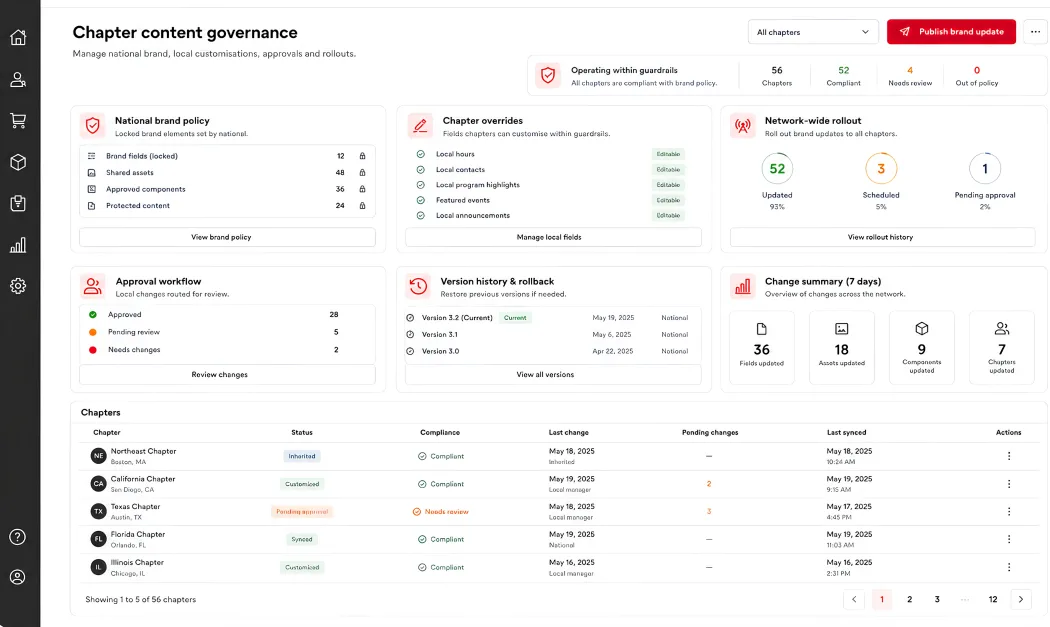
Every page, program, and policy has a national version owned by HQ and a chapter version owned by the chapter. Chapters inherit the national version by default. You decide which fields a chapter can override (local hours, contact details, event listings, local sponsor logos) and which stay locked (logo, brand colours, member benefits language, legal copy). Changes at HQ flow down automatically. Changes at the chapter stay scoped to that chapter.

Yes. Chapters get their own sub-section, their own admin permissions, and their own catalog scope for local programs and events. They can swap hero images, local sponsor logos, event listings, and local content. They cannot change locked brand elements, national policy pages, or member benefits language. Approval gates can require HQ sign-off for changes outside the configured permitted scope.

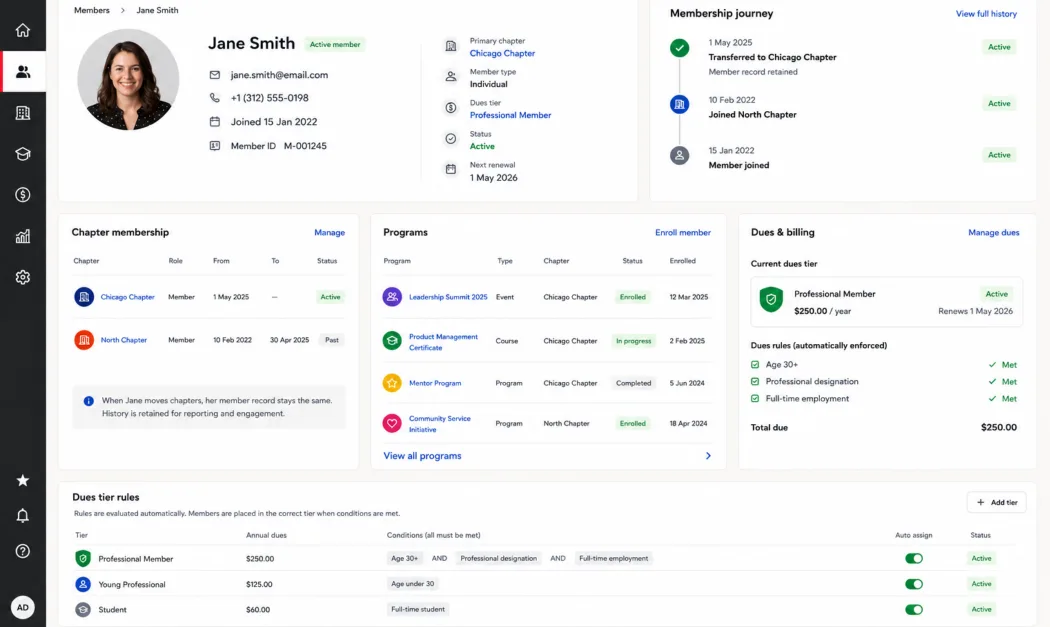
A member has one record on the platform, tied to a primary chapter and any additional chapter affiliations. The public site, the member portal, the LMS, and event registration all read from this one record. A member who moves from a state chapter to a national role keeps the same record, the same CPD history, and the same dues record. You do not run separate identity systems per chapter.

Both options work. Some networks fully replace iMIS, Personify, or NetForum with Core dna's custom-entity model for members, chapters, dues, and certifications. Others keep their AMS in place during a phased migration and bridge it to Core dna while the public site, member portal, and LMS move first. Discovery confirms which path fits your data, your renewal cycle, and your team. Most networks fully consolidate within 18 to 24 months.

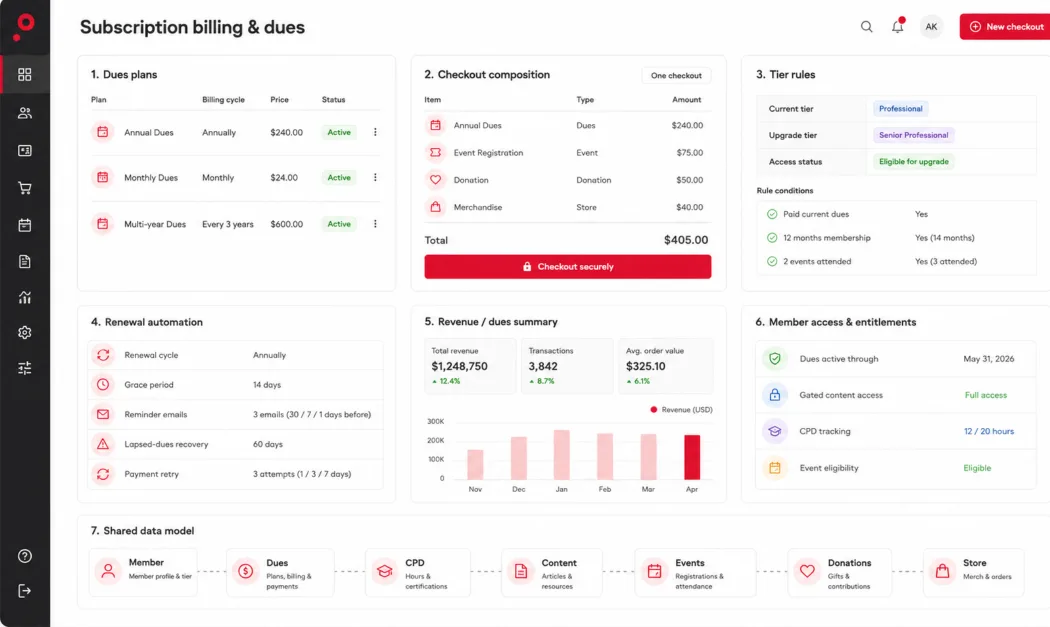
Yes. The member portal handles annual dues, monthly dues, multi-year dues, tier upgrades, one-time event registrations, donations, and merchandise on one checkout. Dues renewal runs as a subscription with the renewal date, grace period, and lapsed-dues recovery configured per tier. Lapsed members lose gated-content access on the date you specify. Renewal emails are triggered by the platform, not by a separate email tool.

Yes. CPD progress, certification status, and continuing-education credits are tracked as part of the member record. A member completing a course in the LMS updates their record on the platform without an external integration. Certification renewal can require completed CPD as a condition, and dues renewal can require active certification. The full chain works inside one data model.

Content can be public, member-only, or scoped to a specific member tier, chapter, certification, or program. Access rules read from the member record at request time. A member who downgrades a tier loses access at the moment the downgrade saves. A member whose dues lapse loses access on the date you configure. Search and SEO crawlers see what you let them see.

Yes. Events are first-class entities with their own session catalog, ticket types, registration workflow, and tier-specific pricing. A member at a higher tier sees a different price than a non-member. Registration writes to the member record so CPD credits and conference history sit alongside dues and program history. Multi-day conferences with sub-sessions, workshops, and ticketed extras are supported.

Most national bodies go live in 12 to 20 weeks. Federations with 30 to 100 chapters and deep AMS integration run 20 to 28 weeks. Discovery (3 to 4 weeks) maps your member data, your chapter governance, and your integrations. Configuration and integration (8 to 14 weeks) build the custom entities, migrate the AMS data, and wire the payment processor. UAT runs with HQ and one chapter pilot. Deployment includes a real renewal cycle in production before full rollout.

Those tools are association management systems. Strong on CRM, dues, and event registration. Weak on modern public web, weak on chapter governance at scale, and almost always paired with a separate CMS (WordPress, Drupal) plus a separate LMS plus a separate event tool. With that stack, member identity lives in seven places. With Core dna, members, chapters, programs, and dues are modelled on one platform. If you are under 1,000 members with no chapter structure, an AMS-plus-WordPress stack is often enough. For chapter-based networks at scale, the stitching cost compounds.

Agentic = describe the change in plain language; the platform ships it across every property, with approval and audit built in. For a national membership body, that means a Director of Communications says "update the professional-tier renewal copy on every chapter site and refresh the linked CPD compliance language" and the platform drafts the change, previews it per chapter, and stages it for approval. Two humans approve. A diff per chapter is shown before ship. Rollback is armed.

The platform does not change brand voice, tier rules, dues amounts, or member benefits language without an explicit instruction and an explicit approval. Agentic is a layer on top of the same governance you already run — chapter scope, role permissions, approval gates, audit log — not a replacement for it. It is also opt-in per workflow. Networks that prefer to keep agentic dormant on Day 1 and turn it on per workflow after the first renewal cycle are common.

FOUR OPERATIONAL REALITIES AN AMS, A CMS, AND AN LMS THAT DON'T KNOW ABOUT EACH OTHER
The renewal gap
A member's dues lapse in your AMS. The website doesn't know. They keep getting in. By the time you catch it, three more chapters have the same problem.
Chapter drift
National updates the brand. Half the chapters never get the memo. You notice when a member emails support about wrong contact info.
CPD records that don't talk to dues
A member completes a course in the LMS. The AMS doesn't get it. Member services reconciles by hand. Multiply by 200 chapters.
OR IT COULD JUST BE ONE RECORD
One member. One platform. Every chapter, every program, every dues cycle, in one place.
GET STARTED

See it run on your network.

Book a 30-minute call. We will walk you through how Core dna would be configured for your member data model, your chapter governance, and your existing stack. Trusted by national membership networks across professional, community, faith-based, and trade shapes.