
Replace your CMS, commerce, and integrations. One migration. No sprawl.
Consolidates your entire digital stack: content, commerce, and the integration layer between them, onto one managed platform. One migration. Zero integration overhead.
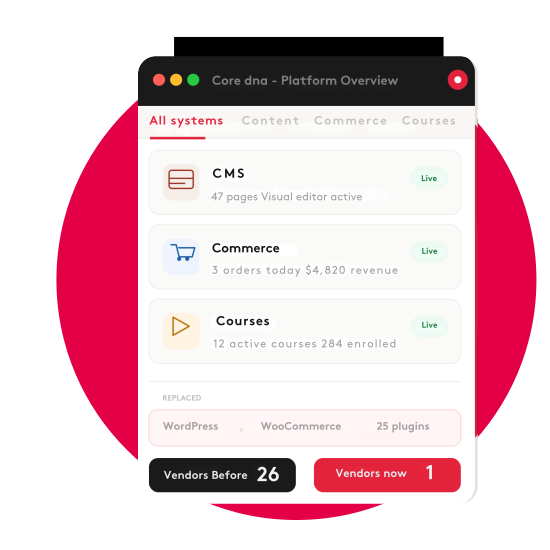
Most companies don't have a CMS problem.They have a stack problem.
A CMS. A commerce platform. An integration layer between them. Three vendors, three contracts, three points of failure.
See how Core dna solves that.
Client Words

""We were running four separate systems, WordPress, Shopify, a custom LMS, and a DevOps pipeline to hold it together. Core dna replaced all of it."
Mackenzie Thompson. CEO at Save a Life
- Reduced from 4 vendors to 1 platform
- Live in 8 weeks including data migration
- 60% reduction in platform maintenance overhead
- Marketing team publishes independently, zero dev tickets
Core dna Consolidation Capabilities
Every B2B workflow, handled natively.

CMS Migration Support
Parallel running during transition. Content mapping, URL preservation, SEO redirect management. No downtime.

Built-in eCommerce
Products, pricing, checkout, subscriptions, and B2B ordering native to the platform. No separate commerce vendor required.

Integration Orchestration
Connect ERP, CRM, payment gateways, and marketing tools through Core dna's built-in orchestration layer. No middleware.

Multi-site Architecture
Manage unlimited sites from one instance. One migration consolidates every property, not one site at a time.

Visual Editor for Marketers
Marketing teams manage and publish content independently after go-live. No developer dependency for content operations.

Managed Infrastructure
Platform updates, security patching, and scaling handled by Core dna post-migration. Your team owns none of it.
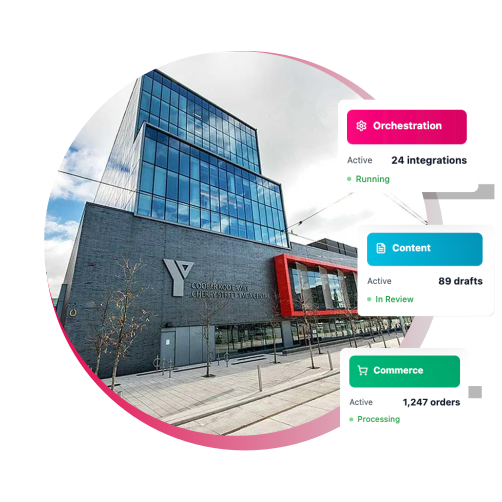
Manage content and commerce from one interface.
Core dna combines CMS, ecommerce, integration orchestration, and managed infrastructure, all in one instance. One migration replaces everything.
- Content management with API-first delivery and visual editor
- eCommerce native to the platform:products, pricing, checkout, B2B ordering
- Built-in orchestration layer: ERP, CRM, payments, no middleware
- Managed SaaS: infrastructure, upgrades, and patching handled by Core dna
One migration. Your team finally focused on growth, not infrastructure.
With Core dna's managed platform, you consolidate without losing flexibility. Your developers keep the API-first architecture they want. Your marketing team stops waiting for engineering. Your IT team stops maintaining integrations.
- No separate CMS, commerce platform, and integration layer
- No plugin conflicts, and security patches
- No integrations that break when either vendor updates their API
- No running a DevOps function just to keep the stack stable

Core dna vs the alternatives.
Nobody chooses between Core dna and just Shopify Plus, or just Magento. They choose between Core dna and the complete stack those platforms require to do the same job. That's the honest comparison.
| Capability |
Core dna
One platform |
Magento stack
Magento + AEM / WordPress + extensions |
Shopify Plus stack
Shopify Plus + Contentful + middleware |
|---|---|---|---|
|
Platform model
|
One platform | Magento + AEM / WordPress + extensions | Shopify Plus + Contentful + middleware |
|
Vendor footprint
|
1 vendor · 1 contract | 4–7 vendors · 30+ extensions | 3–4 vendors · custom integration |
|
CMS — content management
|
Native | Adobe Experience Manager or WordPress | Contentful / headless CMS |
|
Ecommerce
|
Native | Magento Commerce | Shopify Plus |
|
Course / LMS delivery
|
Native | Third-party LMS extension | Third-party LMS |
|
CMS ↔ commerce integration
|
No integration needed | Custom build / middleware | Agency-built middleware |
|
Visual editor for marketers
|
Native | Page Builder extension | Builder.io or custom |
|
Multi-site management
|
Native | Magento Multi-Store | Not native |
|
Security & updates
|
Managed by us | Your team / agency — Magento patches are frequent & critical | Partial — Shopify only |
|
Implementation
|
Core dna team | Agency required | Agency required |
|
Ongoing managed services
|
Platform support included | Retainer required | Retainer required |
|
When something breaks
|
We fix it | Your problem | Your problem |
|
True cost of ownership
|
Platform subscription + managed services | Platform licence + agency + extensions + DevOps + security patches | Platform + agency + middleware + retainer |
Trusted by



Frequently asked questions
Core dna is designed as a unified digital experience platform that combines several core capabilities in one system, including:
- CMS for content management
- ecommerce for online sales
- orchestration for workflow automation
- multi-site management
- integrations with ERP, CRM, and external systems
Platform consolidation means replacing multiple disconnected systems, such as a CMS, ecommerce platform, LMS, and workflow tools, with a unified platform that manages content, commerce, and operations from one place.
Instead of integrating many separate tools, companies use a single platform to reduce complexity and streamline digital operations.
Many digital teams run their websites, ecommerce, and workflows on separate platforms. This often creates integration complexity, duplicated data, and slower operations because teams must coordinate across multiple systems.
Platform consolidation solves this by bringing CMS, ecommerce, and automation capabilities into a single platform, allowing organizations to manage content, products, and workflows from one place while reducing operational overhead and system complex
Core dna includes an orchestration layer that allows teams to build automated workflows across content, commerce, and integrations.
Examples include:
- automating content publishing approvals
- triggering promotions based on inventory updates
- synchronizing product data with ERP systems
- launching localized versions of websites
This orchestration layer helps organizations automate processes that previously required manual coordination across multiple systems.
Yes. Core dna supports hybrid headless architecture, which means teams can deliver content and commerce through APIs while still using built-in editing and management tools.
This allows developers to build flexible front-end experiences while marketers retain control of content and operations.