
Manage Every Global Storefront. From One Dashboard.
Core dna is the Digital Orchestration Platform built to synchronize complex multi-site ecosystems with native automation, AI translation workflows, and enterprise governance from a single secure instance.
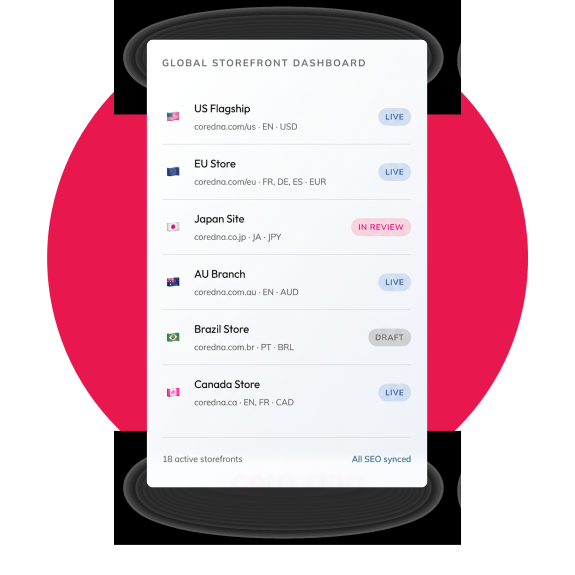
Find out how Core dna can help with you manage Multi-site ecosystems
Global standards enforced. Local teams empowered.
Core dna lets you define at the content-type level what's locked globally, what regional teams can adapt, and what AI generates. One governance model for every site, applied automatically.
- Define what is global, what is local. Set governance rules at the content-type level
- Multi-tenancy means infrastructure and reusable components are shared while content, databases, and permissions stay isolated.
- Launch new storefronts in hours, not sprints: Clone a fully-governed template, apply your regional rules, and launch
- Prevent content drift before it starts: Centralized content push means one update propagates everywhere, with governance intact.

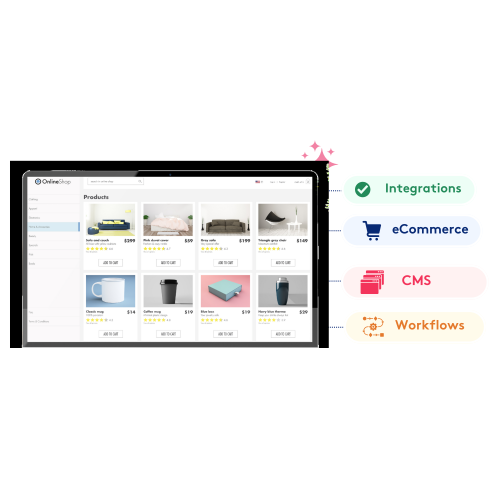
One platform. Every capability your global operation needs.
Built for enterprise brands that need to manage multiple sites without multiplying their operational complexity or security surface area.
- Global master content, publish once, everywhere: A single product description, brand message, or legal update cascades instantly across all sites.
- Local autonomy within defined guardrails: Regional teams control what they're empowered to control without ever touching what's locked at the global level.
- Regulatory & compliance variance, built in: GDPR in Europe. CCPA in California. Industry-specific rules, data residency requirements by region.
From one content action to a fully orchestrated global publish.
When a product or page is created in Core dna, a chain of automated steps executes across every connected storefront and locale, without a single manual intervention. No plugins. No third-party connectors.
Define Your Triggers
Any system event becomes a trigger: content publish, stock change, price update, user role change, form submission, scheduled time.
Chain Actions & Logic
Connect AI agents, API calls, approval queues, notifications, and data syncs into governed multi-step jobs. Visual builder, no code needed for non-tech teams.
Deploy AI Agents
Build custom AI microservices for content creation, translation, structured data generation, or personalization, all inside your platform.
Govern & Audit
Every workflow action is logged. Every content change is traceable. Every cross-site update has an owner. Full audit trails, not bolted on, built in.
Every SEO task across every site, automated.
Core dna can automates the entire technical SEO stack, so your team focuses on strategy, not spreadsheets.
- Auto-injected structured data: Product, Organization, and Local Business schema applied per content type, every site, every locale.
- Localized search signals: Hreflang, canonical URLs, and language-specific sitemaps, configured once, maintained automatically.
- AI-readable content architecture: Entity signals and consistent brand data that GEO and AEO engines can parse and cite.
- AI-generated metadata: Titles, descriptions, alt text, and structured data generated instantly on publish across all locales.
Connects to your existing stack. Doesn't replace it.
Core dna integrates with your ERP, CRM, DAM, PIM, and translation services via native webhooks and APIs.
All orchestration runs inside Core dna, your data never passes through third-party connectors.

ERP & PIM Sync
Connect to SAP, Oracle, Salesforce, and major PIM systems. Product data flows in from your master record and Core dna propagates it with locale-specific pricing and availability.
Translation Services
AI-powered first drafts. Add connectors to your professional translation platforms. Content flows into review queues automatically, human approval built into the workflow.

Identity & SSO
Enterprise SSO via SAML, OAuth, and LDAP. One identity layer across every brand, site, and region. MFA enforced at the platform level, not left to individual site admins.

Analytics & Data Platforms
Push events to your data warehouse, CDP, or analytics stack. Track performance across every storefront from one place, with consistent event schema so your data team isn't normalizing spreadsheets.

Digital Asset Management
Connect your existing DAM or use Core dna's built-in asset hub. Images are served via global CDN, auto-compressed, and tagged with governance rules that prevent unauthorized assets appearing on brand sites.

Commerce & Payments
Multi-currency, multi-payment-gateway, multi-tax-rule support across all storefronts. Define pricing and checkout rules per market from one central product catalog that powers every region independently.
What it's like to work with Core dna
This isn't a handoff model. It's an ongoing partnership designed to reduce risk and keep momentum high.
Direct access
Work directly with the people who build and maintain the platform.
Close collaboration
We partner with your internal team to shape the right architecture.
Risk reduction
We stay involved as your needs evolve. Every launch, every update, every challenge, your dedicated team helps keep delivery steady.
Core dna vs the enterprise alternatives.
Nobody chooses between Core dna and just Contentful, or just Sitecore. They choose between Core dna and the complete stack those platforms require to orchestrate a global multi-site operation.
| Capability | Core dna One platform · One vendor 1 vendor · 1 contract | Contentful stack Contentful + commerce layer + middleware 3–5 vendors · custom integration | Sitecore stack Sitecore XM + OrderCloud + integrations 5–8 vendors · SI required | Liferay stack Liferay DXP + commerce + extensions 4–6 vendors · heavy implementation |
|---|---|---|---|---|
| Architecture | ||||
| Platform model | ✓ One unified platform | CMS only — commerce & SEO sold separately | Modular products — XM Cloud, OrderCloud, CDP purchased separately | Monolithic DXP — broad but complex to configure |
| Vendor footprint | ✓ 1 vendor · 1 contract | 3–5 vendors · separate contracts | 5–8 vendors · SI partner required | 4–6 vendors · implementation partner required |
| Multi-tenancy | ✓ Native — shared infra, isolated data | Organizations feature — limited isolation | Available — complex to configure | Available — requires significant setup |
| Multi-site management | ||||
| Manage all sites from one dashboard | ✓ Native | No true cross-site orchestration | Available — requires SXA configuration | Available — complex permissions model |
| Clone governed site templates | ✓ Launch new storefronts in minutes | Manual setup per space | Possible — requires SI and sprint cycles | Weeks of configuration per new site |
| Global content push (one update → all sites) | ✓ Native governance intact | No native cross-space propagation | Possible via SXA — custom dev required | Staging/publishing workflows — not automatic |
| Global locked / local editable governance | ✓ Defined at content-type level | Requires custom middleware | Workflow rules available — complex to govern | Role-based — not content-type governance |
| Commerce & content | ||||
| CMS — content management | ✓ Native | ✓ Native (headless) | Sitecore XM Cloud | Native DXP |
| Ecommerce | ✓ Native | Commercetools or Shopify required | Sitecore OrderCloud (separate product) | Liferay Commerce (add-on module) |
| CMS ↔ commerce integration | ✓ No integration needed | Agency-built middleware required | Custom connector between XM + OrderCloud | Within platform but heavy config |
| Multi-currency, multi-tax, multi-payment | ✓ Native per market | Requires commerce platform + configuration | OrderCloud supports this separate licensing | Available — complex setup per region |
| SEO & AI automation | ||||
| Auto-injected structured data (schema.org) | ✓ Every site, every locale, automatic | Developer implementation | Not native, custom per template | Not native |
| AI-generated metadata on publish | ✓ Titles, descriptions, alt text — all locales | Third-party AI plugin required | Not native | Not native |
| Hreflang & localized sitemaps | ✓ Configured once, maintained automatically | Manual or plugin dependent | Available dev configuration required | Partial, manual maintenance |
| No-code automation builder | ✓ Visual builder — no SI needed | Zapier/Make required | Custom dev or SI required | Not native |
| Governance & compliance | ||||
| Full audit trail (built-in) | ✓ Built in | Available | Available | Available |
| Regulatory variance by region (GDPR/CCPA) | ✓ Compliant | Compliant | Compliant | Compliant |
| Enterprise SSO (SAML, OAuth, LDAP) | ✓ Available | Available | Available | Available |
| Operations & support | ||||
| Implementation | ✓ Core dna team | SI / agency required | SI partner required | SI / agency required |
| Ongoing managed services | ✓ Platform support included | Retainer required | Retainer required | Retainer required |
| When something breaks | ✓ We fix it | Your problem | Your problem | Your problem |
| True cost of ownership | Platform subscription + managed services | Platform + commerce layer + middleware + agency + retainer | Multiple Sitecore products + SI fees + ongoing support contracts | Platform licence + implementation partner + ongoing agency retainer |
Real Results from Real Businesses
See how leading brands transformed their operations with Core dna
YMCA Toronto
after consolidating 7 systems into one
Standard Process
Expanded to 86 marketplaces without hiring a single developer
Clark Rubber
70 franchises unified under one digital platform, managed by a lean team
RANDYS Worldwide
4× revenue growth in year one with 7 integrated sites and 30,000 SKUs
Frequently asked questions
Core dna is engineered for global scale using a unified multi-site architecture.
Our platform allows you to manage dozens of international storefronts from a single dashboard. Through master-to-sub synchronization, any update made to your primary site can be automatically pushed, translated, and adapted for regional markets.
This includes localized pricing, inventory rules, and unique regional content, allowing for rapid global expansion without the manual overhead of traditional CMS platforms.
Yes, we do. Our ability to support multiple brands and site instances (by geography, market, etc.) on one platform and access all data in a unified dashboard is one of the features that makes us attractive to multi-brand manufacturers and retailers. For more information about our multi-site feature, click here.
Yes. Core dna is a native hybrid headless CMS, giving you the best of both worlds: the API-first flexibility of headless and the visual, "what-you-see-is-what-you-get" editing of a traditional system.
Our multi-tenant architecture is built to handle an unlimited number of sites, sub-brands, and regional stores from a single dashboard. You can spin up new sites in minutes using shared components while maintaining unique branding and localized logic for every instance.
One platform.
Every storefront.
No fragmentation.
See how Core dna can consolidate your multi-site operations into a single managed instance, with native orchestration, automated SEO, and enterprise governance built in.